The Technology
Atomic Dielectric Resonance is a proprietary coherent pulsed electromagnetic scanning technology that interrogates the subsurface from the surface — reading the dielectric and resonance properties of subsurface materials at depth, without drilling.
What is ADR?
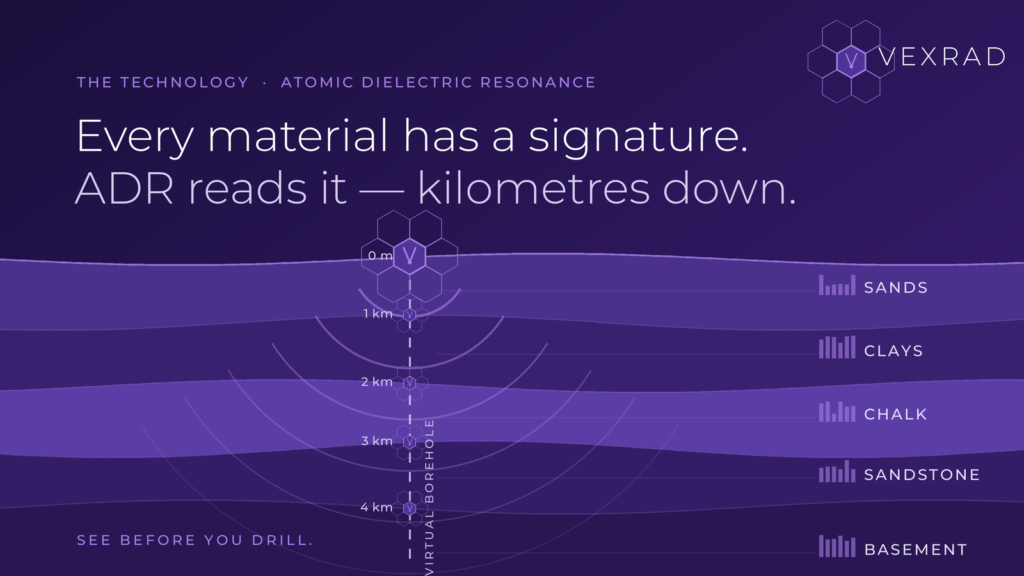
Every material — rock, fluid, mineral — has a characteristic electromagnetic signature. When interrogated with a precisely tuned coherent pulsed signal, subsurface formations respond in ways that are measurable, repeatable, and geologically meaningful.
By analysing the returning signal — its energy, frequency content, and attenuation — VEXRAD can identify lithological boundaries, classify rock types, estimate fluid content, and model subsurface conditions. The result is a detailed subsurface picture built entirely from surface-acquired data.
How ADR works
–1 · Signal transmission — a coherent pulsed EM signal is transmitted into the subsurface from a surface-deployed instrument.
–2 · Subsurface response — formations interact with the signal by their dielectric and resonance properties; each lithology and fluid gives a characteristic signature.
–3 · Analysis & interpretation — returning signals are processed with CalcDataMix into a detailed log of lithology, boundaries, fluid indicators, and proxy temperature.
CalcDataMix — our analytical framework
A multivariate framework developed by Dr G. Colin Stove and colleagues, published in peer-reviewed literature (Stove et al., 2013). It integrates ADR signal parameters — energy ratios, frequency components, attenuation indices — into a coherent subsurface model, with machine-learning lithology classifiers trained on calibration wells.
–Composite lithology logs from surface to target depth
–Probabilistic lithology classification with quantified uncertainty
–Reservoir interval identification and ranking
–Proxy geothermal temperature profiles
–Cross-well calibration frameworks for multi-site programmes
45-feature input vector · ensemble classifiers · stratified cross-validation · quantified accuracy — not black-box outputs.
How ADR compares
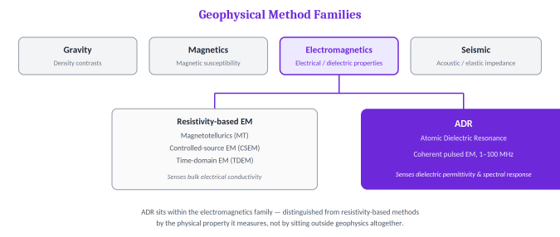
Every geophysical survey solves an inverse problem, and every inverse problem is non-unique: many earth models fit the same data. A gravity high can be dense mafic rock or a sulphide body. A magnetic high can be barren magnetite or a mineralised system. A seismic bright spot can be gas or simply a change in lithology. The answer is not a better single method — it is independent measurements of the same ground, so competing interpretations can be ruled out instead of argued over.
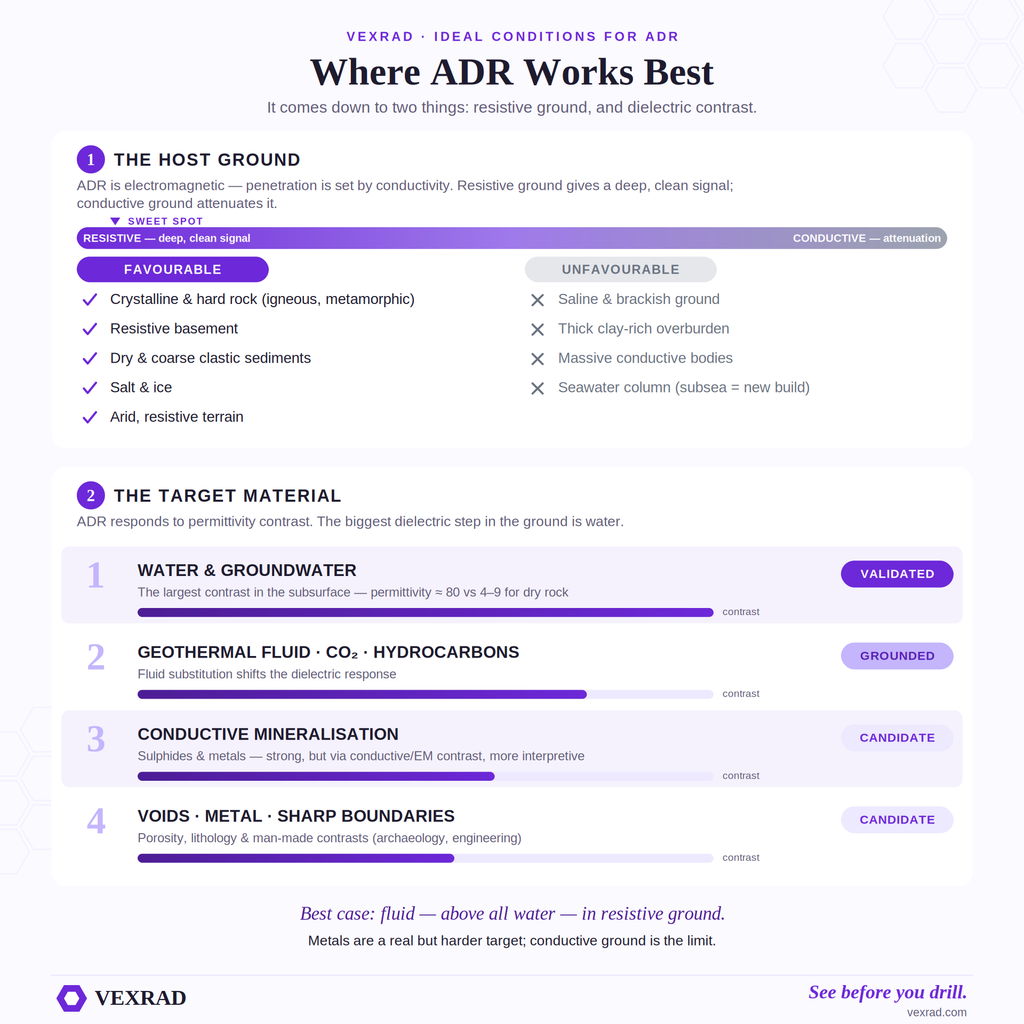
No single best method, here’s where ADR honestly leads and trail:
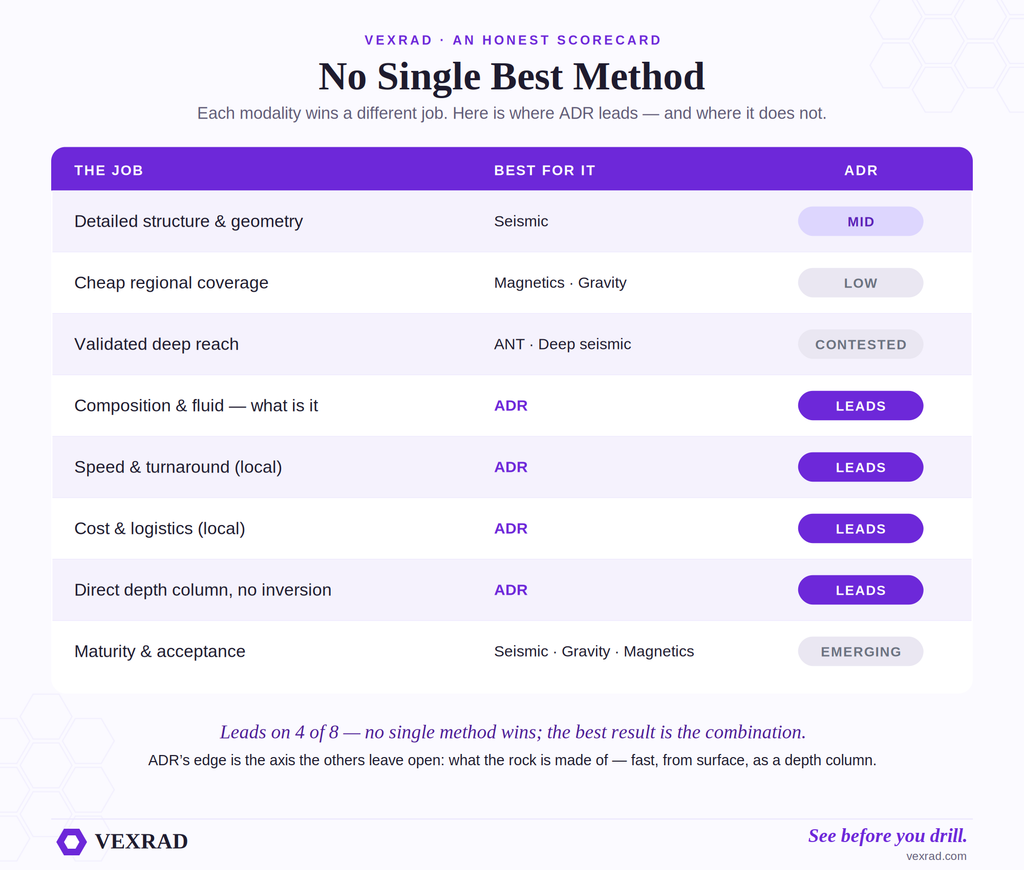
We’d rather tell you where ADR is strong and where it isn’t. It’s an electromagnetic method, so it favours resistive ground and is limited by conductive cover; and it responds to dielectric contrast, so it reads fluid — water most of all — with real clarity, while metals are a higher-value but more interpretive target. The panel below is our honest map of ideal conditions: see before you drill.

“The instruments will improve, the images will sharpen — but the idea is sound, and ideas that are sound outlive the people who have them.” Dr G. Colin Stove, Inventor of ADR