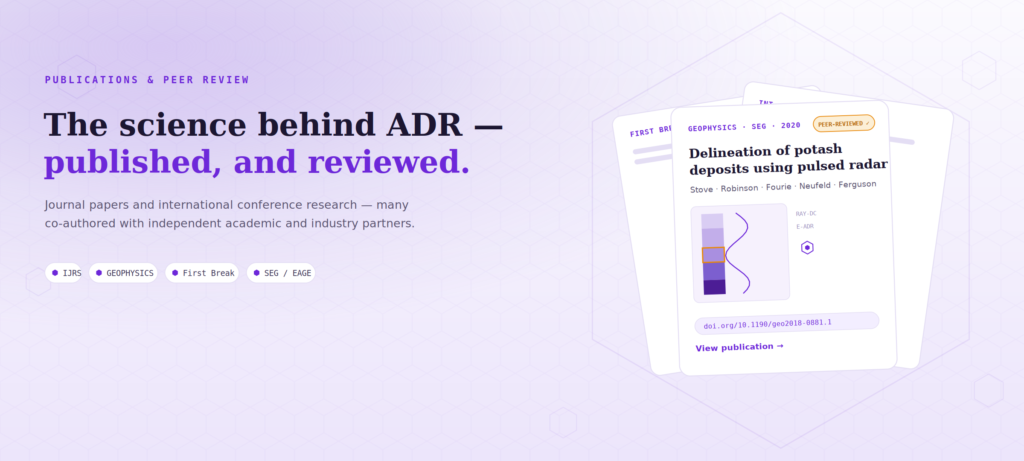
The science behind ADR
The science behind ADR
Published research. Independent collaboration. Real-world validation.
Atomic Dielectric Resonance (ADR) has been investigated through peer-reviewed journal papers, international geoscience conferences, numerical modelling and field validation. This library brings together selected research behind the technology and its application to deep subsurface exploration.
Peer-reviewed journal papers
Research covering ADR physics, deep subsurface sensing, mineral exploration, geothermal applications and numerical modelling.
Ground penetrating abilities of a new coherent radio wave and microwave imaging spectrometer
International Journal of Remote Sensing, Vol. 34(1), 2013
Foundational peer-reviewed research examining the ground-penetrating, imaging and material-classification capabilities underpinning ADR.
View publication →Identification and delineation of potash deposits in Saskatchewan, Canada, using pulsed radar technology
GEOPHYSICS, Vol. 85(6), 2020
Deep potash exploration case history from Saskatchewan, Canada. Pulsed-radar measurements were compared with geological control and used to investigate differentiation of halite and potash-bearing sylvinite within the Prairie Evaporite Formation at approximately 1,500 m depth.
Read full paper →Green technology to help calculate subsurface geothermal zones and temperatures before drilling
First Break, Vol. 40(10), 2022
Application of ADR measurements to geothermal exploration, including investigation of subsurface zones and temperature interpretation before drilling.
View publication →Environmentally friendly, low-impact, low-power electromagnetic technique for mineral exploration
First Break, Vol. 41(8), 2023
ADR applied to mineral exploration, with emphasis on lower-impact electromagnetic subsurface investigation within the energy-transition and critical-minerals environment.
View publication →Modeling and simulation of low-frequency subsurface radar imaging in permafrost
Computer Science and Information Technology, 6(3), 2018
Numerical investigation using FDTD and ray-tracing approaches to examine low-frequency radar propagation and subsurface imaging.
View publication →Deep detection & technology validation
Research examining detection range, electromagnetic propagation and the physical basis supporting deep subsurface ADR measurements.
Deep detection range test for a low-frequency subsurface radar system
84th EAGE Annual Conference & Exhibition, 2023
Deep-detection field testing involving the STFC Boulby Underground Laboratory and ICL, providing reviewable evidence relevant to subsurface detection range.
View publication →Ground penetrating abilities of broadband pulsed radar in the 1–70 MHz range
SEG Technical Program Expanded Abstracts, 2014
Investigation of broadband pulsed-radar ground penetration across the 1–70 MHz range and an important part of the technical foundation behind deep ADR investigation.
View publication →Geothermal
Research into geothermal exploration, temperature interpretation and subsurface monitoring using pulsed electromagnetic measurements.
Monitoring subsurface temperature gradients using pulsed electromagnetic waves and machine learning
5th EAGE Geoscience & Engineering for the Energy Transition, 2024
Investigation of pulsed electromagnetic measurements and machine-learning techniques for monitoring subsurface temperature gradients.
View publication →Empirical and simulated earth-friendly subsurface geothermal surveillance technology
10th UK Geothermal Energy Symposium, 2023
Geothermal surveillance research co-authored with independent industry and academic collaborators.
Contact us for a copy →Environmentally friendly, low-power electromagnetic technique for shallow geothermal exploration
EAGE Near Surface Geoscience Conference, 2023
Application of low-power electromagnetic subsurface sensing to shallow geothermal exploration.
View publication →Helping de-risk the exploration for suitable geothermal drill targets
Geothermal Resources Council Transactions, Vol. 44, 2020
Research focused on the use of ADR to provide additional subsurface evidence when assessing prospective geothermal drilling locations.
View publication →Critical minerals
Published work exploring ADR for mineral targeting beneath cover, sulphide detection and gold exploration.
Progress towards the development of a sulfide-targeting tool for mineral exploration under cover
EAGE Mineral Exploration Symposium, 2020
Investigation of ADR as a potential sulphide-targeting technique for mineral exploration where prospective geology is concealed beneath cover.
View publication →Gold and sulfide targeting using Atomic Dielectric Resonance (ADR)
ASEG Extended Abstracts, 2015
Mineral-exploration study examining sulphide and associated gold targeting using ADR measurements at significant depth.
View publication →Groundwater
Technical publications examining pulsed electromagnetic methods for groundwater exploration and subsurface water detection.
Extending the reach of radio waves for subsurface water detection
CSEG Recorder, Hydrogeophysics Edition, October 2018
Technical article discussing ADR and the use of radio-wave measurements for subsurface groundwater investigation.
View publication →Finding water using a pulsed radar
Symposium on the Application of Geophysics to Engineering & Environmental Problems, 2021
Conference research examining pulsed-radar techniques for identifying subsurface water and supporting groundwater exploration.
View publication →Some publisher websites may require institutional access or payment. Where a legitimate full-text version is publicly available, VEXRAD links directly to that version.
From published science to your subsurface target.
The value of geophysics is ultimately measured by what happens when predictions meet ground truth. Explore VEXRAD’s field evidence and case studies, or bring us a target and we can assess whether ADR is a suitable fit for your project.
Publisher paywalls apply to some papers; links resolve to the official DOI or journal page. For a copy of a conference paper, please get in touch.