We show our working
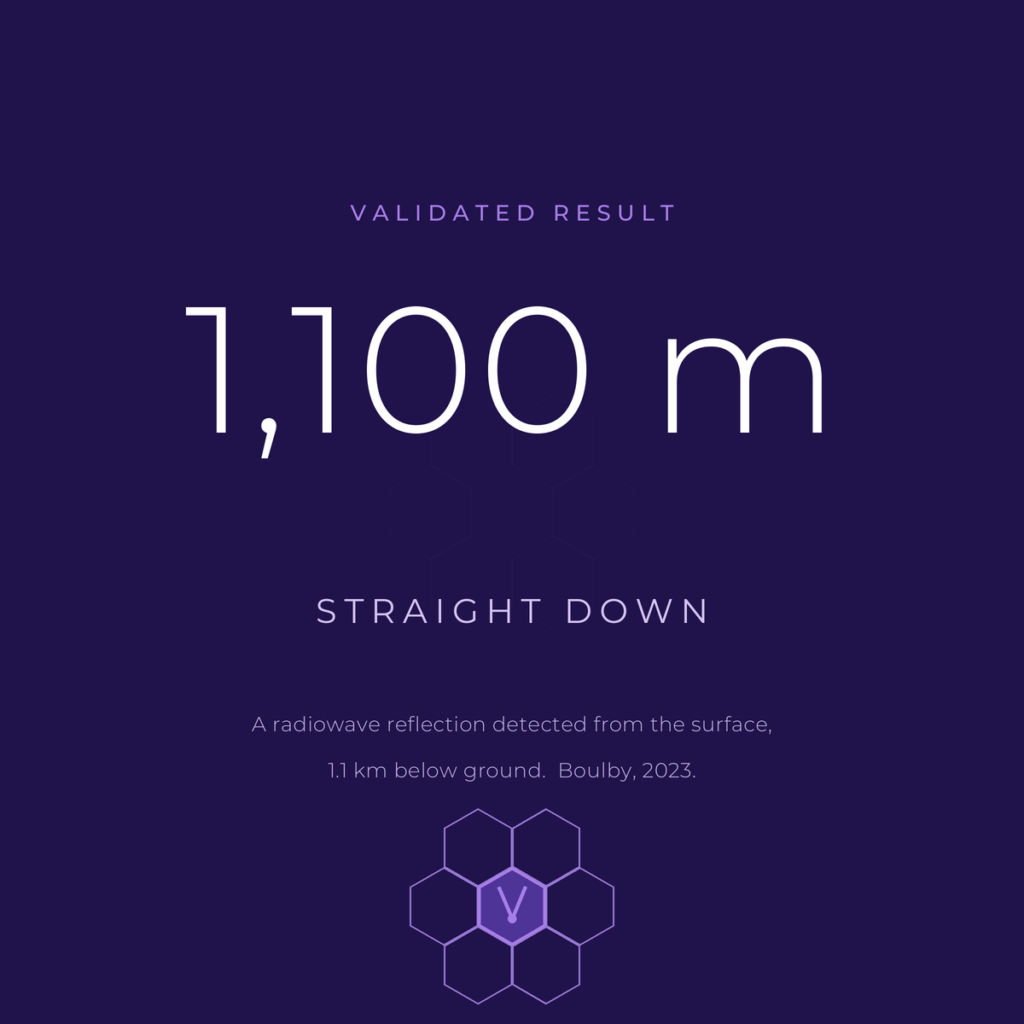
We don’t ask you to believe ADR. We show you the evidence.
Atomic Dielectric Resonance is only as credible as the evidence behind each result.
That is why VEXRAD applies a structured evidence standard to ADR programmes — separating what has been demonstrated against ground truth from what is supported by the physics, what remains a candidate, and where the method has known limitations.
Measure. Test. Compare. Report. Repeat.
Our objective is not to make every result look positive.
It is to determine what the data can — and cannot — support.
The VEXRAD Evidence Standard
Every significant ADR finding earns an evidence tier. Nothing is promoted beyond what the available ground truth supports.
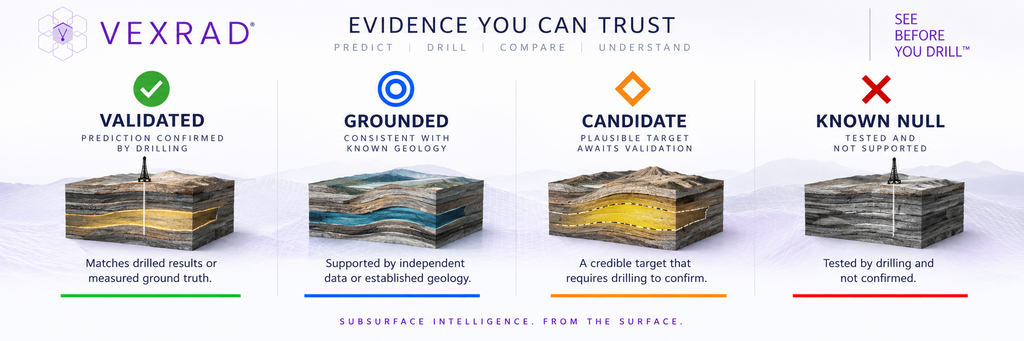
VALIDATED
Demonstrated against independent ground truth.
The ADR result has been tested against an appropriate reference dataset — such as a drill log, wireline measurement, core, assay, temperature measurement, seismic interpretation or subsequent drilling outcome.
Where possible, the validation is blind or genuinely pre-drill.
Examples include:
- ADR lithology compared with drilled lithology
- ADR sandstone probability compared with logged sand content
- Pre-drill ADR permeability indicators compared with subsequent mud-loss intervals
- ADR temperature proxies compared with measured downhole temperatures
- Predicted mineralisation indicators tested by subsequent drilling
GROUNDED
Supported by the physics and available data, but not yet independently confirmed.
The response is consistent with the expected physical or geological behaviour and may be supported by calibration data, but there is not yet sufficient independent ground truth to call the finding validated.
Grounded does not mean proven.
It means supported, but still requiring confirmation.
CANDIDATE
A credible target requiring testing.
A candidate is an ADR anomaly or interpretation that warrants further investigation or drilling but has not yet been independently confirmed.
A candidate is not presented as a discovery, resource or proven geological feature.
It is a target.
KNOWN NULL
An expected result that ADR does not resolve — or a negative prediction subsequently confirmed as negative.
We regard negative evidence as valuable.
A method that only reports successful outcomes cannot be properly assessed.
Known nulls help define the operating envelope of ADR and prevent the technology from being presented as capable of resolving features that the evidence does not support.
We test predictions against drilled outcomes.
ADR is most valuable when it makes useful subsurface predictions before drilling. VEXRAD compares those predictions with subsequent borehole, wireline, geological and other ground-truth data — and reports both successes and limitations.
How we test ADR
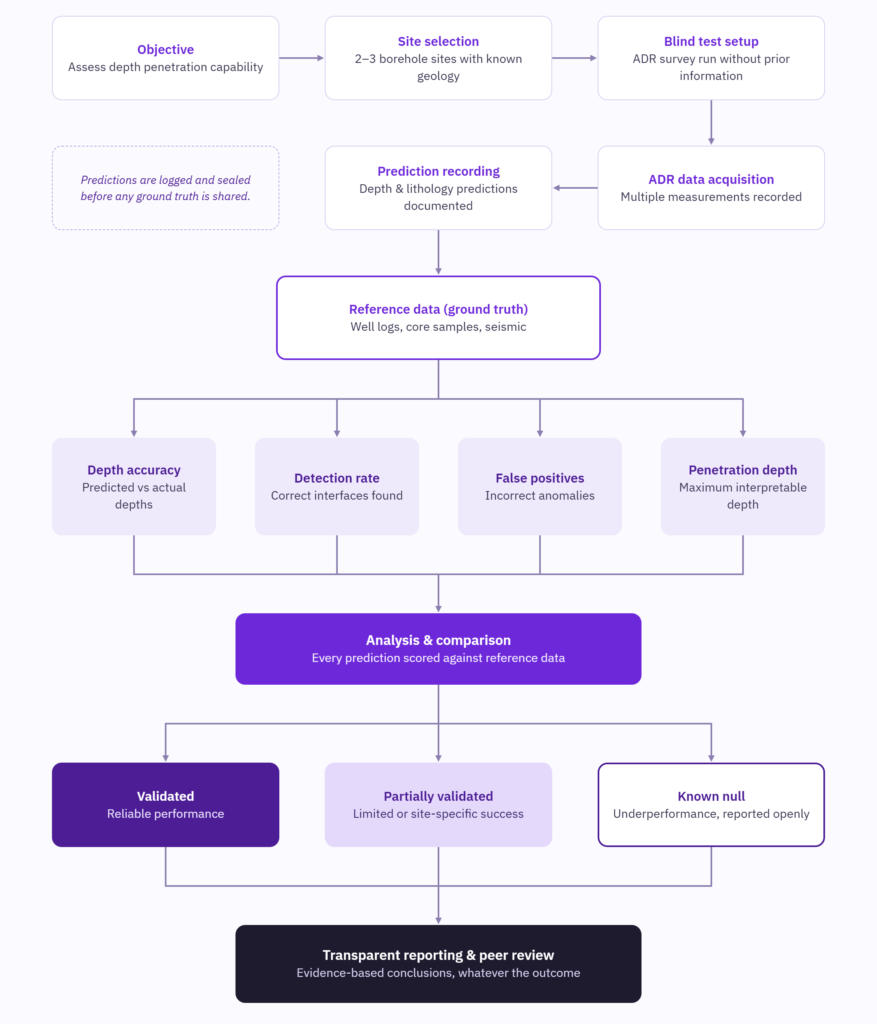
We don’t ask you to take ADR on trust. Every capability we claim is tested the same way: blind, against boreholes with known geology, and scored against independent ground truth.
A blind test, by design
We select two or three borehole sites where the geology is already known from drilling. Our team runs the ADR survey without access to that information, then records its depth and lithology predictions. Those predictions are logged and sealed before any well logs, core or seismic are shared with us.
Scored on four measures
Once the ground truth is revealed, each prediction is compared against it:
- Depth accuracy: how closely predicted interface depths match the measured ones
- Detection rate: how many real interfaces ADR correctly identified
- False positives: anomalies ADR reported that aren’t there
- Penetration depth: the maximum depth at which the signal remains interpretable
Every outcome is reported
A result is classed as validated, partially validated, or a known null. We publish all three. A null result tells you where ADR shouldn’t be used, and that is as valuable to your programme as a positive one. It’s why the results on this page are labelled by evidence tier rather than presented as uniform success.
Test it on your ground
If you have boreholes with known geology, we’d welcome running a blind evaluation with you. You hold the answers; we make the predictions. Discuss a field trial
WHAT ADR DOES — AND DOESN’T — CLAIM
✓ ADR CAN HELP IDENTIFY
Lithology
Changes and boundaries between geological units.
Structures
Subsurface structural features and geological boundaries.
Target intervals
Depth intervals that warrant further investigation.
Reservoir indicators
Responses potentially associated with reservoir characteristics.
Subsurface anomalies
Changes in measured ADR responses that may warrant geological interpretation or further investigation.
× ADR DOES NOT GUARANTEE
Grade
ADR is not an assay.
Permeability
A permeability indicator is not a direct permeability measurement.
Flow rate
Productive flow requires physical testing.
Reserves
Resource and reserve estimation requires appropriate geological, drilling and economic evidence.
Drilling success
No subsurface technology can remove geological uncertainty completely.
ADR is a decision-support technology — not a substitute for drilling.
Its purpose is to provide additional subsurface intelligence before capital is committed to the next drill hole.
Peer-reviewed methodology
The CalcDataMix multivariate framework underpinning our interpretation was developed and published in peer-reviewed scientific literature — Stove, G.C. et al. (2013). ADR and its applications have been developed and published over more than three decades, originating with inventor Dr G. Colin Stove.
Active commercial validation
In European geothermal exploration our outputs are routinely calibrated against wireline datasets from existing boreholes. Results have demonstrated:
–Lithology boundaries consistent with wireline DENS and GR logs to drill-depth precision
–Probabilistic sandstone classification with quantified accuracy vs core and wireline
–Proxy temperature profiles correlating strongly with geothermal gradient measurements
–Consistent performance across multiple sites, supporting cross-well calibration
The team behind the technology
–Dr G. Colin Stove — Founding Inventor and Legacy — invented ADR and has led its scientific development for over thirty years; named inventor on ADR patents and lead author of the CalcDataMix methodology, across geophysics, materials science and electromagnetic sensing.
–Gordon Stove — Co-founder & CEO, Domain Expert & Project Lead — leads VEXRAD’s technical programmes and client deliverables; co-author of CalcDataMix (2012) and has directed ADR analysis across geothermal, mining and characterisation programmes internationally, presenting at EAGE.
–Dr Kees van den Doel — Domain Expert & Scientific Lead — leads VEXRAD’s science programmes; co-author of CalcDataMix and Signal Reflection methods (2012) and has directed ADR research developments, presenting at EAGE and SEG.
Our analytical standards
We apply formal uncertainty quantification to every deliverable — no point estimates without confidence intervals. Classifiers are evaluated via stratified cross-validation with reported accuracy, precision, recall and F1, and we flag where calibration data is limited.
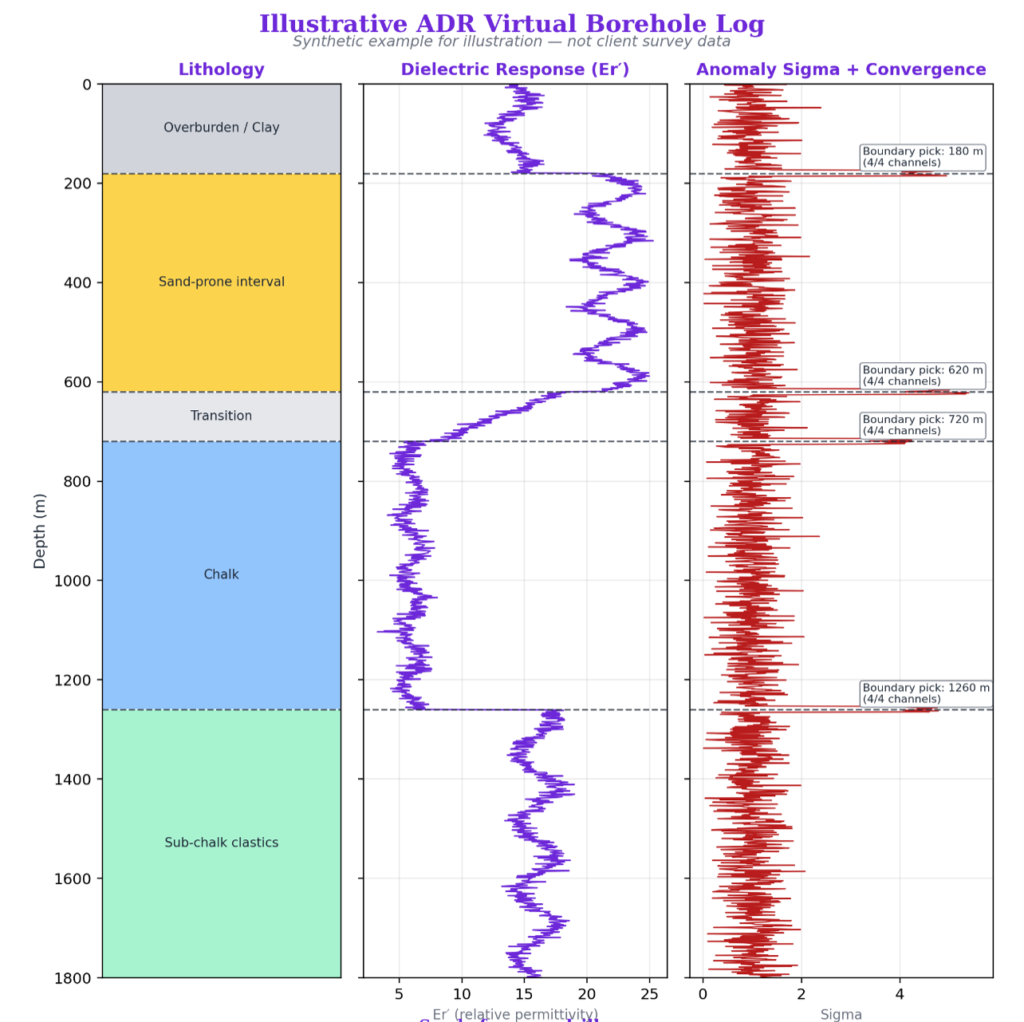
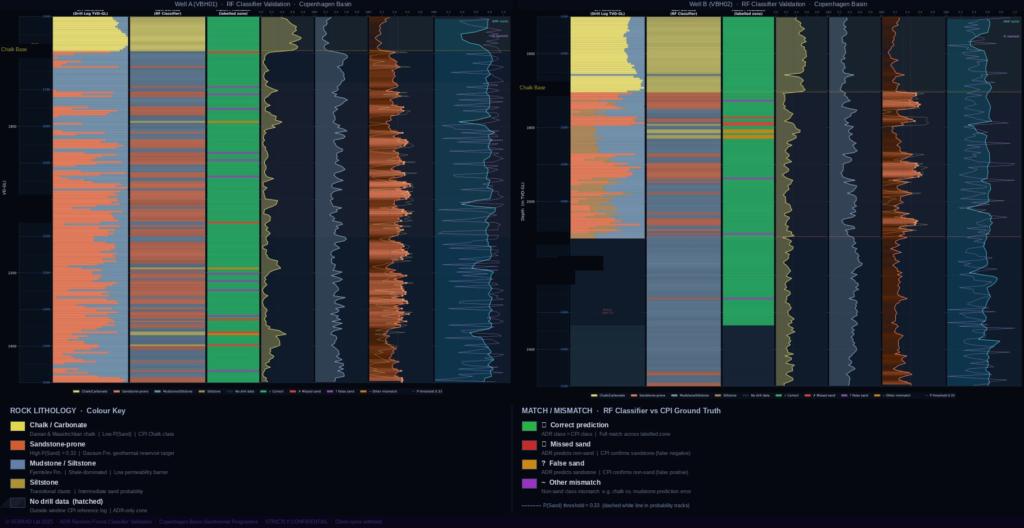
A virtual borehole survey is faster to deploy and far less costly than an appraisal well and can be acquired non-invasively ahead of a drilling decision. For onshore geothermal developers, this supports site screening, well-count reduction, and de-risking of a drilling programme using an additional, independent data channel — one that has been checked against real drilled outcomes rather than offered on projected capability alone.
PREDICT → DRILL → COMPARE → REPORT

“A drill gives you one thin thread of truth at enormous cost. I wanted to see the whole cloth before we ever put steel in the ground.” Dr G. Colin Stove, Inventor of ADR