VEXRAD • Carbon Storage & CCUS
See More Before You Inject.
Independent subsurface intelligence for CO₂ storage characterisation, injection planning, containment assessment, baseline surveying and monitoring using Atomic Dielectric Resonance (ADR).
The CCS challenge
Five questions before injection.
Where will the CO₂ go?
Storage architecture, reservoir continuity and heterogeneity.
What pathways could it follow?
Faults, fractures, structural corridors and anomalous intervals.
Will containment perform as expected?
Caprock continuity and intervals requiring further investigation.
Where should wells be located?
Additional evidence for appraisal, injection and monitoring-well decisions.
Can change be detected over time?
Repeat measurements can be compared with a pre-injection baseline to investigate measurable change.
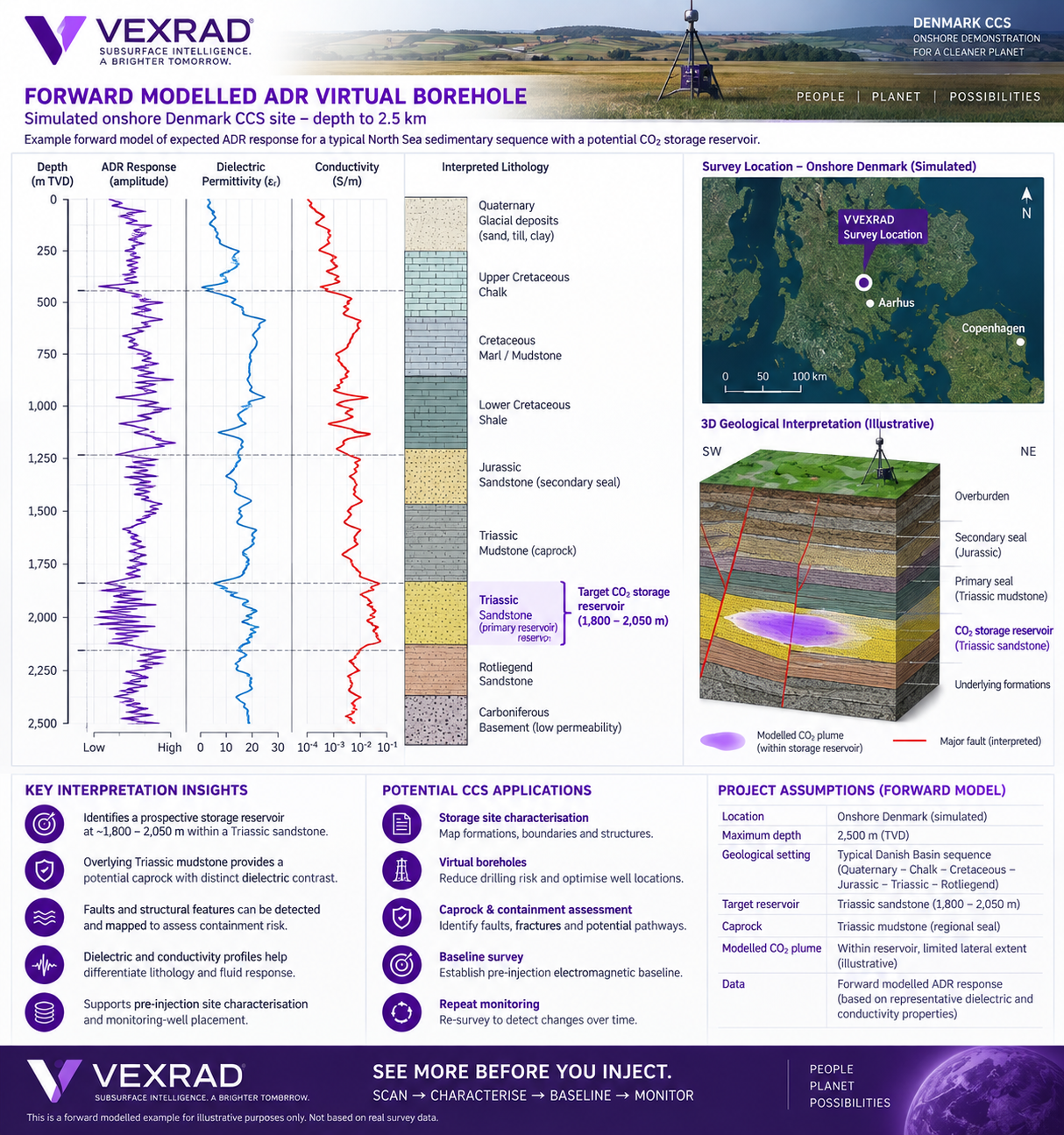
Forward-modelled concept
An ADR Virtual Borehole for a prospective CO₂ storage site.
The example below illustrates how ADR outputs could be interpreted across a simulated onshore Danish Basin sequence to investigate reservoir, seal, structure and candidate monitoring questions.
Where ADR can contribute
From characterisation to repeat surveillance.
Storage-site characterisation
Investigate formations, boundaries, dielectric response, conductivity, structures and anomalous intervals.
Virtual Boreholes
Create depth-referenced profiles ahead of physical drilling to support appraisal and monitoring-well planning.
Caprock & containment intelligence
Investigate caprock continuity, structural complexity, potential faults, fracture corridors and anomalous pathways requiring further evaluation.
Injection-site intelligence
Compare prospective locations and provide another dataset for integration into geological and reservoir models.
Pre-injection baseline
Establish repeatable electromagnetic measurements before CO₂ injection.
Repeat monitoring
Re-survey selected locations during and after injection to investigate measurable changes relative to baseline conditions.
Targeted surveillance
Focus measurement where another layer of evidence matters most.
Rather than blanket coverage, ADR surveys can focus on higher-priority locations such as injection wells, monitoring wells, known faults, suspected migration pathways, caprock areas, legacy wells, boundary areas and anomalies identified by other datasets.
Before injection
Add an independent view before committing further drilling capital and help prioritise locations requiring detailed appraisal.
At baseline
Establish repeatable measurements at selected locations before injection begins.
Through time
Return to the same locations and investigate changes relative to baseline as part of an integrated surveillance programme.
A practical evaluation programme
Test the technology before scaling it.
VEXRAD proposes a controlled evaluation on an existing CCS site with strong subsurface control. Selected control information can be withheld so ADR interpretations are generated and locked before independent comparison.
Commercial entry point
VEXRAD CCS Technology Evaluation
Start with a paid, controlled evaluation rather than an enterprise-scale deployment.
The operator provides a location with good subsurface control and withholds selected information. VEXRAD acquires ADR, produces a locked interpretation and then compares the results with the control dataset.
Evaluation deliverables
- Defined geological questions and survey objectives
- Agreed survey locations and acquisition plan
- ADR processing and Virtual Borehole outputs
- Locked interpretations where appropriate
- Comparison against independent control data
- Performance review and recommendations
- Option for baseline and repeat-monitoring locations
Evidence-led positioning
What VEXRAD is — and is not — claiming.
VEXRAD does not claim that ADR alone proves storage integrity or CO₂ plume behaviour.
CCS deployment should be evidence-led, integrated with established methods and validated against independent geological, geophysical and drilling information. The proposed evaluation programme is designed to establish where ADR adds useful information before stronger monitoring claims are made.
Frequently asked questions
VEXRAD for carbon storage & CCUS
How could ADR support a CCS project?
Potential applications include storage-site characterisation, depth-referenced Virtual Boreholes, caprock and structural investigation, injection and monitoring-well planning, pre-injection baseline measurements and repeat surveys.
Does ADR replace seismic or monitoring wells?
No. VEXRAD positions ADR as a complementary measurement layer to be interpreted alongside seismic, wells, geological models, reservoir simulation and established MMV technologies.
Can ADR monitor a CO₂ plume?
VEXRAD proposes an evidence-led test pathway: establish a pre-injection baseline, repeat measurements through time and compare any measurable changes with independent CCS monitoring data. Stronger plume-monitoring claims require site-specific validation.
What is a CCS Virtual Borehole?
A depth-referenced ADR interpretation generated from surface measurements that can be used to investigate subsurface variability and help prioritise where appraisal or monitoring evidence is most valuable.
What is the recommended first project?
Select an existing CCS site with strong seismic and well control, define the geological questions, acquire ADR with selected control data withheld, lock the interpretation and then independently compare the results.
Scan → Characterise → Baseline → Monitor
Bring us one carbon storage site.
Select a site with strong seismic and well control. Define the geological questions first. Lock the ADR interpretation. Then let the independent data show whether ADR adds useful subsurface intelligence.